
How Offering a “Middle Option” Creates a Sense of Value (aka The Decoy Effect)

It’s Friday night.
You worked hard all week.
So you decide to treat yourself and your sweetie to a movie.
You walk up to the concession stand and see two sizes of popcorn: a small for $3.00 and a large for $7.00.
Hmmm… tough call.

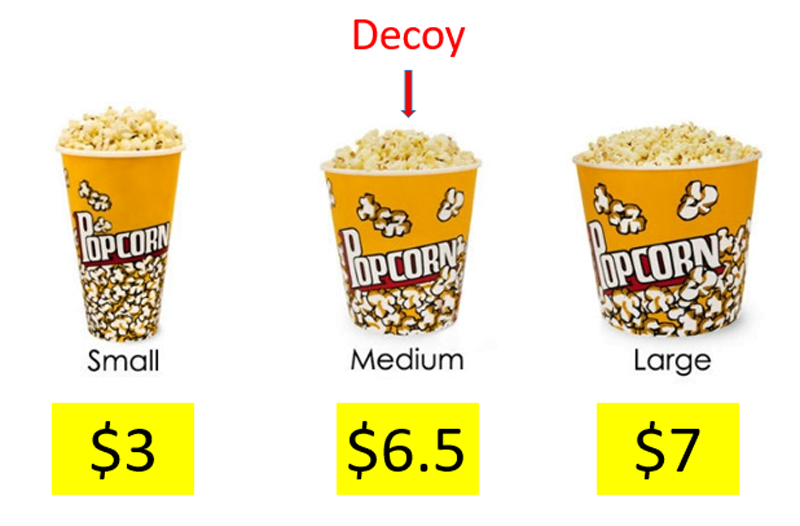
Then your eye drifts to the middle option — a medium for $6.50.
Wait a minute, for $0.50 more I can get the entire large popcorn instead of a medium that isn’t much bigger than the small???
Suddenly, the large looks like a steal.
You grab it, walk away satisfied you got the best value and a great deal, and never stop to wonder why a size you weren't even considering just pushed you toward the most expensive item on the board.
Welcome to the “Decoy Effect” — one of the most powerful psychological tools in modern marketing.
What Exactly Is the Decoy Effect?
Formally known as the asymmetric dominance effect (or sometimes the "attraction effect"), the Decoy Effect is a well-documented cognitive bias in which consumers shift their preference between two options when a strategically inferior third option — the "decoy" — is introduced. The decoy itself is never meant to be chosen. Its only job is to make one of the original options look dramatically more attractive by comparison.
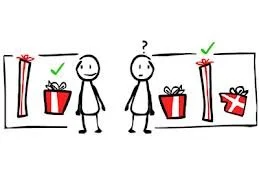
The mechanics are precise: the decoy must be completely inferior to the "target" option (the one the marketer wants you to buy) but only partially inferior to the "competitor" option. This asymmetry is what gives the effect its name — and its power.
The phenomenon was discovered in 1981 by researchers Joel Huber, John Payne, and Christopher Puto, who tested it across scenarios involving beer, cars, lottery tickets, and restaurants. It was later popularized by Duke University behavioral economist Dan Ariely in his influential 2008 book Predictably Irrational.
Why Does It Work? The Psychology Behind the Choice
At its core, the Decoy Effect exploits a fundamental quirk in human cognition: we are terrible at evaluating value in absolute terms, but surprisingly good at relative comparisons.

As Ariely famously put it, "We don't have an internal value meter that tells us how much things are worth. Rather, we focus on the relative advantage of one thing over another."
We are comparison machines — and savvy marketers know exactly how to set up that comparison to their advantage.
The effect works through several overlapping psychological mechanisms:
Reduced choice anxiety. When consumers face too many options, they experience what psychologist Barry Schwartz called the "paradox of choice" — a kind of paralysis that can actually prevent a purchase. A well-placed decoy eliminates one option almost immediately, simplifying the decision and reducing anxiety.
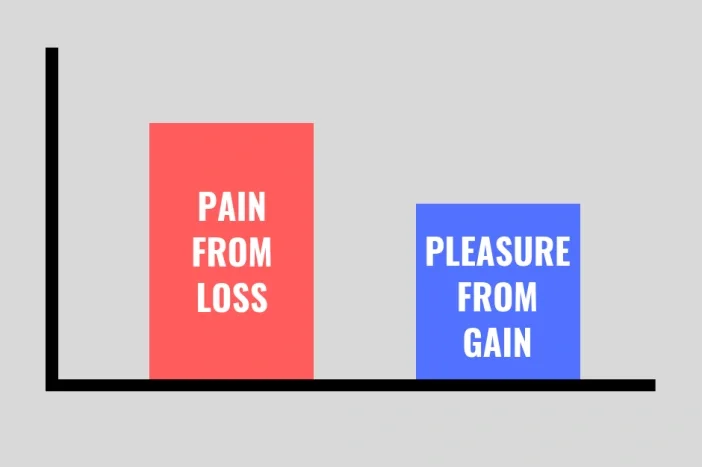
Loss aversion. The decoy makes consumers fear "leaving value on the table." Once you see that the large popcorn is barely more expensive than the medium, passing it up feels like a loss.
The illusion of rationality. Perhaps most deviously, the Decoy Effect makes you feel smart for choosing the target option. Your brain experiences a kind of cognitive reward for identifying the "obvious" best deal — even though the deck was stacked.
Real-World Examples You've Already Encountered
The Decoy Effect is everywhere once you start looking.
The Economist Subscription Test: In one of the most cited demonstrations, Dan Ariely analyzed The Economist's subscription pricing: a web-only plan, a print-only plan at roughly double the price, and a combined web-and-print plan priced identically to the print-only option.
When Ariely tested this with MIT students, none of them chose the print-only option — it existed purely as a decoy. But its presence caused 84% of students to choose the premium combined subscription, compared to just 32% when that middle "decoy" option was removed.
Streaming and SaaS Pricing Tiers: That "Professional" plan wedged between Basic and Enterprise on virtually every software pricing page? Frequently a decoy, engineered to make the top-tier offering feel like an obvious upgrade.
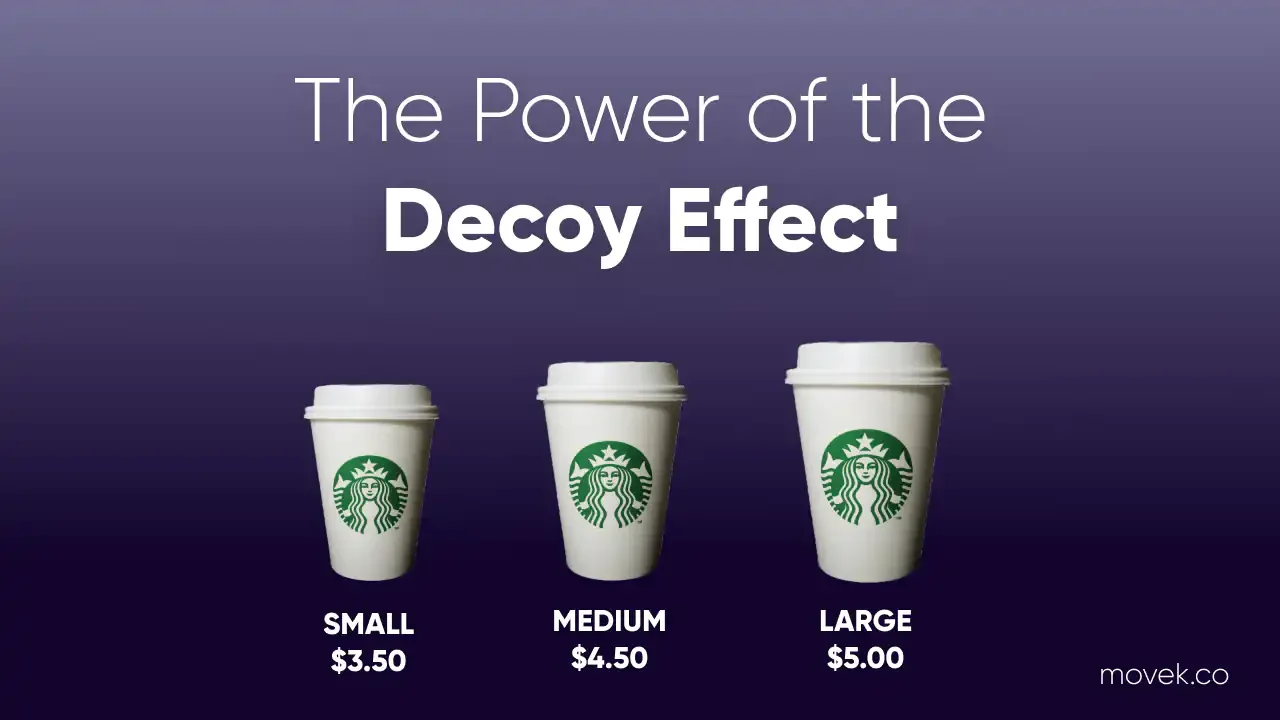
Coffee Shop Sizing: The classic example. A small at $2.50, a medium at $4.25, and a large at $4.50. The medium decoy makes the large feel like an irresistible bargain.
Legal and Consulting Services: A UK law firm that introduced a "Premium Consultation" tier — priced just below its flagship "Comprehensive" package but offering slightly less — recorded a 43% increase in Comprehensive bookings with zero change in overall traffic.
Using It Ethically (and Spotting It When It's Used on You)
For marketers, the Decoy Effect is a legitimate and effective pricing tool — but it carries an important caveat: trust is the first casualty of manipulation that feels cheap.
When customers sense the tactic is deceptive, brand perception suffers. The most effective applications of the Decoy Effect are those where the decoy still delivers genuine value; the asymmetry just makes the target shine brighter by comparison.
As consumers, awareness is our best defense. Before committing to what feels like the "obvious" choice, ask yourself: Would I still pick this if the other options weren't on the table? That single question can cut through the noise remarkably quickly.
The Decoy Effect is just one example of how context shapes perception. A product is never evaluated in a vacuum — it's always judged against whatever surrounds it.
Understanding that principle won't just make you a better marketer. It might just save you from an overpriced tub of popcorn.

Need Help Getting Started?
If you need help leveraging proven techniques in your next campaign or any other direct marketing effort, let us know.Jacobs & Clevenger can help you use our proven techniques and tactics to help increase the performance of programs you’re already running or kick off a new one.
J&C has over 40 years of direct marketing experience and would be happy to learn more about your company and your goals. Contact us today. That way we can give you an honest assessment of how we can work with you to achieve better results.
