
Why Direct Marketing Still Delivers the Best Return
And AI Makes It Even More Human

There's a conversation happening in a lot of CMO offices right now.
Programmatic spend isn't converting the way it should.
Your brand campaign looks great but attribution is a mess, and
Email open rates are declining
What’s more in the back of your mind, you’re asking yourself: are we actually connecting with anyone?
The answer, most likely not. And the fix isn't another martech platform. It's a discipline that's been delivering consistently measurable results since before the internet existed: direct marketing.
The Accountability Gap Nobody Wants to Talk About
Digital advertising made a promise — total measurability, infinite targeting, frictionless scale.
Some of that promise delivered.
A lot of it didn't.
Click-through rates on display ads average below 0.1%. Social reach is pay-to-play. And the metrics that look good in dashboards — impressions, reach, engagement — have an tenuous relationship with actual revenue.
Direct marketing never made that promise.
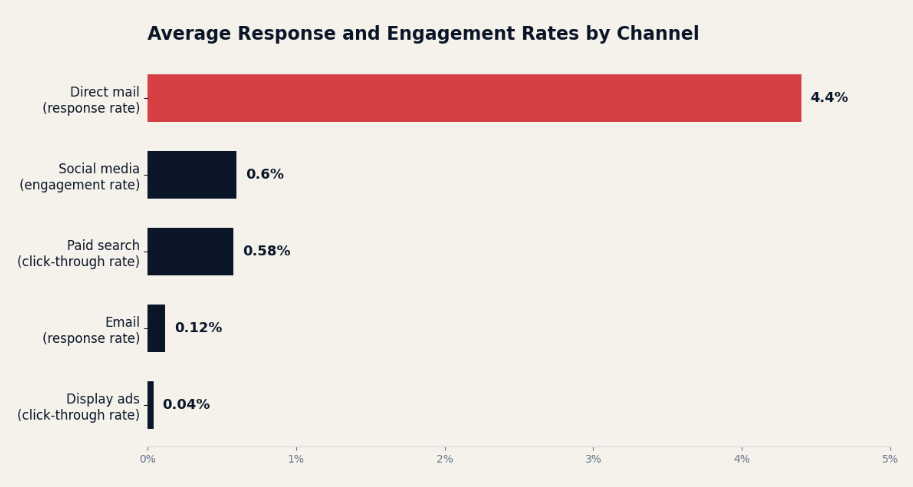
AMA/DMA Response Rate Report (Updated June 2026)
It made a different one: every dollar tracked, every response counted, every campaign a controlled test you can learn from.
Response rate, cost per acquisition, lifetime value, return on ad spend — these aren't approximations in direct marketing. They're the whole point.
“Direct marketing, done well, is the most personal communication channel you can have”
For CMOs in financial services, insurance, and energy — categories with long sales cycles, high customer lifetime value, and heavily regulated messaging — that accountability isn't a nice-to-have. It's a strategic requirement.
The Human Connection Paradox
Here's what surprises most marketers who've spent the last decade chasing digital efficiency: direct marketing, done well, is the most personal communication channel you have.
Not personal in the algorithmic sense of "we showed you this ad because you searched for it 40 minutes ago."
Personal in the sense that a customer receives something that’s actually relevant, addressed to them, that relates to their specific situation, at a moment that matters. A letter. A targeted offer.
A renewal communication that reflects their actual policy history, not a “cohort” they happen to fall into.
That distinction — between surveillance-based personalization and genuinely relevant communication — is one customers feel even when they can't articulate it. It's the difference between being tracked and being understood. And it’s where trust is born.
Where AI Changes the Equation
The knock on direct marketing has always been scale, spend and speed. Building truly personalized communications for large audiences is hard. Testing and optimizing across dozens of variables takes time. Finding the right moment in a customer's lifecycle requires data infrastructure that most teams don't have.
AI is helping to remove those constraints.
With AI integration, the same discipline that made direct marketing the most accountable channel now operates at a speed and granularity that wasn't possible five years ago.
Audience segmentation that once took weeks of analyst time runs in hours. Dynamic content that used to require separate production streams for each segment can now be generated, tested, and refined continuously.
Predictive modeling identifies which customers are approaching a decision point — and what message will move them — before your competitors know they're in the market.
The result isn't marketing that feels more automated. It's marketing that feels more human — because the communication your customer receives actually reflects who they are, what they need, and where they are in their relationship with your brand.
What This Means for Your Return
Better personalization drives better response. Better response drives better ROI. That's not a hypothesis — it's forty years of documented direct marketing results across some of the most demanding categories in business.
“Better personalization drives better response… and better ROI”
When you add AI to that foundation, the compounding effect is significant. You're not just improving response rates on a single campaign.
You're building a real learning system that gets smarter with every interaction — continuously refining the audience model, the message, the offer, and the timing.
For a CMO managing a portfolio of acquisition, retention, and cross-sell programs, you get a better campaign and a competitive advantage that widens over time.
The Real Question
The question isn't whether direct marketing works. Forty years of results answered that for Jacobs & Clevenger. The question is whether your organization is using it with the tools now available to make every customer communication as relevant, as timely, and as human as it can be.
If the answer is no — or not yet — that's a gap worth closing.
Let’s Work Together
Fill out our contact form or give Jacobs & Clevenger a call at 312-894-3000. We’ll have an honest discussion about if and how J&C can help.
