
The honest answer—from an agency that’s been doing it for 40 years
Ready for this?
Digital is the new junk mail.
That's not simply a contrarian take. That's what's happening in your inbox, on your social feed, and in every corner of your browser right now. Programmatic ads. Pop-ups. Retargeting pixels. Email blasts.
The volume is staggering, and the human brain is responding the only way it can — by tuning it out and in many cases, shutting down.
So what does direct marketing do that this digital palaver can't?
This—direct marketing demands a decision. And that’s just the start.
Direct Marketing Returns Immediate, Measurable and Improved Results
Most marketing channels will tell you they're measurable. Direct marketing actually is, down to the penny
Here's the difference: direct marketing operates on a test, learn, and refine cycle that makes every campaign smarter than the one before it. You can test an offer. You measure the response. You learn what worked and what didn't. You refine. You mail again. The next campaign performs better because it was built on real data from real people who either responded or didn't. And at every step of the way, you’re measuring the response rate, the conversion rate, the CPA, the ROI and the bottom line revenue.
“Direct mail… demands a decision”
That's not a theory. That's a system. And it's one of the most powerful things direct marketing does that you may not realize — it gets better over time in a way you can actually see and measure.
But Don’t People Ignore Mail, too?
Yes, they do. And yet the campaign still works.
It’s true, direct marketing's reputation problem is real. Clients walk in — especially today — and the sometimes they say is "isn't that wasteful?" And the truth is, yes a up to 70 even 80 percent of direct mail gets recycled. That number makes a lot of marketers flinch.
But here's what they’re missing: the 10 to 20 percent that doesn't gets opened is doing extraordinary work. Here’s why:
Direct mail is personal. It connects emotionally in a way digital ads simply can’t. Direct mail arrives in your home — not on your phone, not on your laptop or any other digital screen. It’s REAL and it presents itself physically, in your hands.
And when it does, you have no choice but to interact with it. You have to make a decision: Do I keep this? Do I put it on the kitchen counter to look at later? Do I stick it on the refrigerator? Do I call the number right now? Do I go to the website?Do I recycle it?
That decision-making process is the whole game. And here's a number worth remembering: people keep direct mail pieces in their homes for an average of 17 days. Try getting a digital ad to do that.
A Real Campaign. A Real Result.
A few years ago we did a mailing for a client. It was for gas line protection — essentially an insurance product covering unexpected repair costs for the gas lines that run into your home.
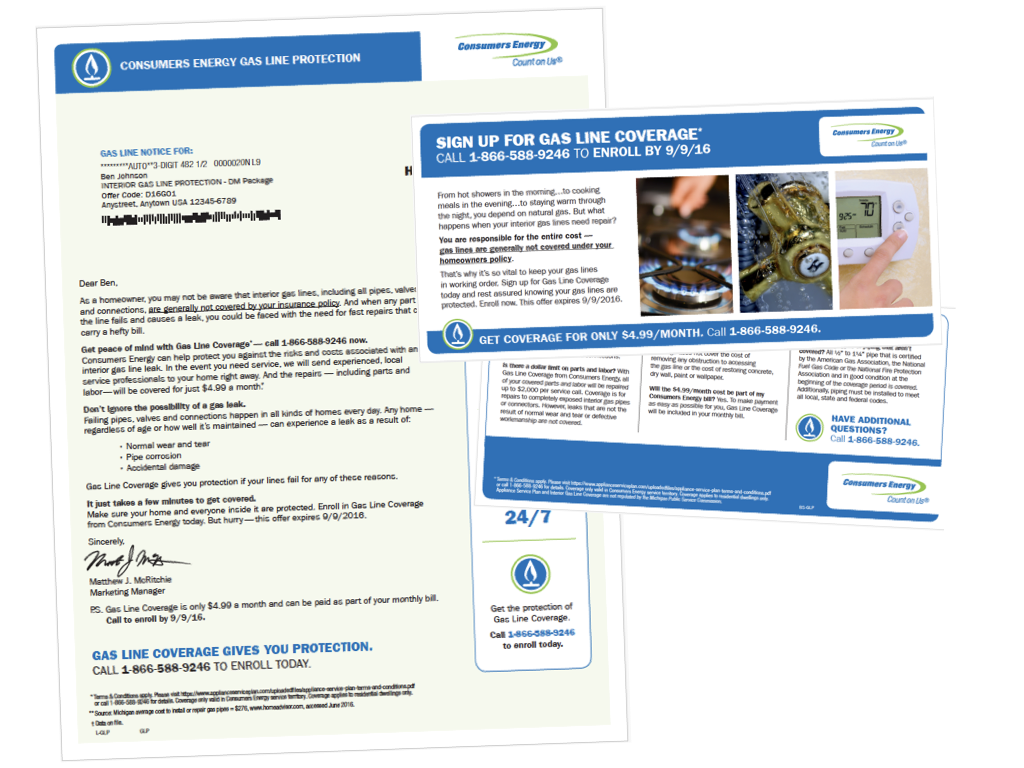
Most homeowners don't realize they're responsible for those lines, which made education part of this campaign.
The piece itself was no-frills. A straightforward one-page letter and a buckslip. No hard sell. Just the facts about the protection, the risk, and a clear offer.
It outperformed every key metric as well as the client’s highest expectations.
“Direct mail is personal. It connects emotionally in a way digital ads simply cannot”
The Landline Analogy
Here's an analogy that will help illustrate the point.
If you had to make an important call, you’d probably reach for your iPhone 15 sitting there with all its power and all its apps. Fair. The iPhone is a solid choice.
Until your battery dies.
You know what works even during a power outage? A landline.
Ok, maybe that’s a stretch. But in that analogy, the battery/power is the economy and the iPhone is digital advertising. When the economy softens — direct marketing keeps working. It kept working in 2008. It kept working in 2020. It will keep working the next time times get tough.
Digital channels are powerful. We absolutely recommend them. But they are not a complete strategy on their own, and they have proven, they are not recession-proof.
Yes, the client spent real money on creative development, list modeling, paper, printing, postage, call center operators. That's the investment direct marketing requires and we'll never pretend otherwise. But the sign-up volume generated by that simple, honest mailing returned the investment almost ten times over.
That's what direct marketing does when it's done right.
Direct and Digital Working Together Is the Real Answer
We're not here to tell you to abandon digital. Not by a long shot. We're telling you not to abandon direct.
The most effective marketing we see today is multi-channel: a direct mail piece supported by email, reinforced by social, driving to a consistent landing page with a consistent message.
Each channel does what it does best. Direct mail gets into the home and demands attention. Email follows up with a reminder. Social keeps the brand visible. Together they keep your message top of mind in a way that any single channel can't.
Clients who understand this recipe are getting real results. Clients who went all-in on digital and are suddenly wondering why their numbers are softening — that’s when we hear from them.
If You Haven't Tried Direct Marketing, Now Is the Time
The irony of the current moment is this: because so many marketers have moved to digital, the mailbox got quieter. It gets genuine attention, not glancing looks, or worse, blocked altogether. That means direct mail stands out more today than it has in years.
If you haven't used direct marketing in a while — here's what you need to know to get started:
You need a good list. A modeled list of people who match your best customer profile is the foundation of everything. Bad list = bad results, no matter how good the creative.
You need a clear offer. Direct marketing is not brand advertising. It asks for a response. Give people a good, beneficial, relevant reason to respond and make it easy to do so.
You need to test. Start with a controlled test. A small sample of your bigger audience. Measure everything. Let the data tell you what to do next.
You need patience. Because direct marketing takes time. But as soon as the results start coming in, you'll know what’s working and where to adjust. Then you can move on and roll out your best effort to the full universe of names you have selected.
“People keep direct mail pieces in their homes for an average of 17 days”
The bottom line is simple: Direct marketing works. It has worked for 40 years. And it still works today. It is working right now for clients who are willing to trust a channel that has proven itself time and time again.
Jacobs & Clevenger is a Chicago-based direct marketing agency with over 40 years of experience helping clients in financial services, insurance, and energy get measurable results. jacobsclevenger.com
