
Traditional direct mail runs on a pretty simple formula.
Show up in someone's mailbox, present your offer, get a response.
One piece.
One chance.
Done.
And sometimes? That's all it takes.

But not every purchase, donation, registration, policy enrollment, application, or business decision happens that fast. Expecting a single mail piece to create awareness, build credibility, answer question, deflate objections, and drive action is a little like proposing marriage on a first date.
Technically possible. Rarely advisable.
That's where multi-touch direct mail comes in.
Instead of treating each piece as a standalone event, you design the campaign as a connected series of moments. Each mailing has one specific job. The first piece sparks curiosity. The next one educates. Another one provides proof. The final one asks for action. When done professionally, people don't just notice your next piece when it arrives.
They notice it, the recognize it and they are more inclined to see what you have to say.
So When Do You Use Multi-Touch?
Things like a flash weekend sale or one-time offer can do just fine with a single piece of mail. You don't need a five-part dramatic narrative arc to move lawnmowers over Memorial Day Weekend.
But multi-touch earns comes into play when the purchase decision is a considered decision, the conversion is worth more, or the story is simply too detailed to cram into one envelope.
Here's where we see it consistently outperform single-drop campaigns:
B2B marketing with longer buying cycles, higher price tags, and multiple decision-makers
High-consideration purchases — financial services, real estate, higher education
Fundraising/Non-profit — where emotional connection and relationship directly drive response
Trade Shows — where anticipation does real marketing work as the date approaches
New Product Intros — where a strategic tease can generate more interest than a full reveal
Financial/Insurance Products — where people need to understand before they'll act
Winback Campaigns — where lapsed customers need more than one reason to come back

Now you’re not simply trying to mail more. The idea is to give each piece a one objective — and let it do only that one thing simply and clearly.
And for Pete’s Sake, Don’t Repeat Yourself
This is a common mistake when attempting a multi-touch campaign. And it can be a costly one:
Drop #1: Here's our product.
Drop #2: Don't forget about our product.
Drop #3: Again, our product.
Drop #4: Did you see our great product.
Drop #5: Once again, our product.
That's an echo chamber, not a cohesive campaign.
In a multi-touch campaign, each touch should advance the story — not simply restate what you’ve already already said in a different envelope. A sequence that actually works looks more like this:
Drop 1: Create curiosity. Illustrate the problem and provide a solution.
Drop #2: Build relevance. Show how your benefits make their life better, richer, easier.
Drop #3: Provide proof. Testimonials, success stories, reviews, awards, etc.
Drop #4: Drive action. Restate the offer deadline, highlight Last Chance, and give them a reason to respond now.
That’s building a story. Not a stale repeat of the same message.

Drop #1 Must Pique Curiosity
Here's something that trips up a lot of marketers. The first touch doesn't need to do everything. In fact, sometimes it works better when it doesn't.
Imagine a new car dealer planning their opening in a new neighborhood or city. The first mail piece could be nothing more than a full-color shot of a new car with a catchy tagline (you can use AI for ideas here, but don’t let it write your final copy):
Something new is right around the corner — OR — a scratch ‘n sniff for that releases that “new car smell”
No prices. No inventory. No 10 reasons to choose us. Just enough to make them curious about what's next.
The second piece reveals the dealer’s location and the opening date.
The third delivers an exclusive invitation to the pre-grand opening with special sales and savings.
By opening day, people in that area have been exposed to the brand three times — and may have even developed a sense of anticipation.
What About B2B?
You're Not Going to Change Anyone's Mind With a Single Postcard
B2B marketers, you got it a little tougher. Chances are nobody is going to uproot their software stack, switch vendors, or reorganize their process because a postcard came in the mail.

These are big decisions. And there are lots of people involved. There’s also budget cycles…internal approvals and real revenue risks involved.
A single piece of mail — no matter how slick or persuasive or well designed — isn't going to suddenly change all of that.
However a strategically timed multi-touch campaign might. It gives you more runway to make your case. Consider a company selling a CRM platform:
Drop #1: "How long does it take your team to enter customer data?
Drop #2: How many hours are wasted in the process — and what’s that costing you in revenue and opportunities?
Drop #3: One of your competitors reduced waste and improved efficiency in the first two months with our platform.
Drop #4: Here's how to put it to work for you. Get a FREE demo, call by xx/xx/xxxx.
Every drop answers a question raised by the previous one. That's how to build a cogent argument that is designed to convince with reason and business rationale. Not simply another email “spray and pray” blast.
Nonprofits May Benefit the Most
Nobody cries at the first five minutes of a movie.
You need time to care about and relate to the characters.
Nonprofit direct mail works the same way. Give donors a chance to get invested before you ask them to act — and they'll show up very differently than if you'd lead with the ask.
Four touches is usually enough to do the job.

Introduce the need through a specific, relatable situation
Illustrate the solution in action so they can see how it works
Prove it works with tangible evidence of what past support has accomplished
Then extend the invitation to join the movement: here's what your contribution makes possible next
Done right, the appeal lands not as a request for money, but as a logical next step in something they've already been part of and feel connected to.
That shift in perception has a measurable impact — on response, on average gift level, and on the kind of long-term donor relationships that sustain an organization for years.
Retail Can Play This Game Too
Sequenced campaigns aren't exclusively for complicated products or long sales cycles. Sometimes you're just selling a really great jacket.
The principle holds regardless of category. Build interest before you ask for the sale. A well-timed teaser — something visually compelling but intentionally incomplete — gets there faster than a catalog that arrives cold and competes with seventeen others retail catalogs in the same week.

Build it simply: intrigue first, then product, then other pieces that make a full ensemble, with an incentive attached. Each piece relates to the next one.
Then consider going a step further.
Design the series so the pieces interact with each other — three cards that form the final sale price, a reveal that only works in sequence. Some people will engage with it like a puzzle. Others won't notice. But the ones who take the time to line them up? They're not browsing. They're buying.
Have Fun With Formats
The format is part of the message. Act like it.
There's a version of multi-touch that involves ordering a large quantity of identical postcards, changing the headline, and calling it a campaign. That doesn’t work. That's not strategy. That's repetition with better scheduling.
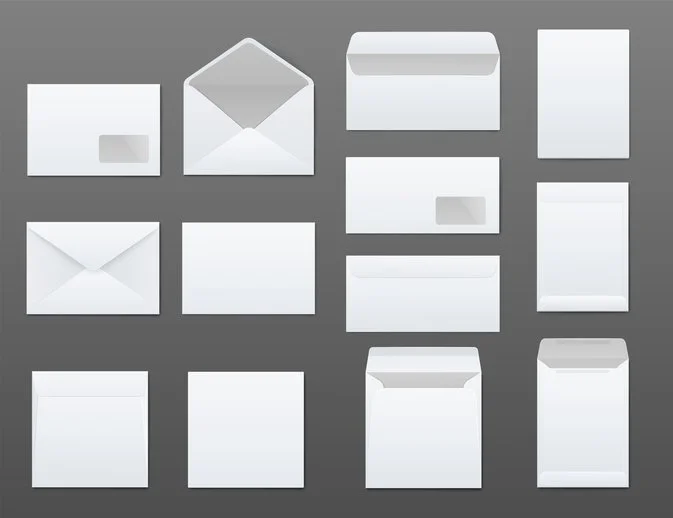
When format shifts with purpose, the recipient feels the progression — even if they can't articulate why. Something small and curious to open. Something with more to say when there's more to say. An envelope when the offer deserves the gravity of an envelope. A stripped-down piece when the only job left is urgency.
Dimensional formats — a box, a cylinder, anything that arrives as an object rather than flat mail — occupy a different category entirely. They create anticipation before they're even opened. They get opened and tend to stick around.
And they cost enough that you shouldn't waste them on cold audiences who've never heard of you. That's what the earlier touches are for. By the time you invest in something dimensional, you should already know this person is paying attention.
Build the budget the way you build the sequence. Start lean and justify the spend.
Their Actions Will Give You Ideas
The smartest thing a multi-touch campaign can do is pay attention.
Behavior tells you everything. Someone who scanned your QR code, filled out a form, or dropped a check into the reply envelope has fundamentally changed their relationship with your campaign. Treating them identically to someone who hasn't opened a single piece is a missed opportunity.

Keep working on the unconvinced with fresh angles and better reasons to act.
For everyone who's already moved — say something that reflects that.
A thank you.
A confirmation that they made the right call.
An invitation to whatever comes next.
The mechanics require your mail data talking to your CRM in something close to real time. When that connection exists, the campaign stops being a predetermined series of touches and becomes something more responsive. More human. The kind of experience that makes people feel like you actually noticed them.
Which, of course, you did.
How Many Touches Is Enough?
Clients ask this question all the time: how many pieces should we send?
It's the wrong question.
And it usually leads to a number pulled from thin air, justified after the fact.
The better question is this: what does someone need to think, feel, and believe before they'll respond — and how much work is left to do?
Start there. If they've never heard of you, that's a longer road. If they're already warm and just waiting for the right offer, maybe you get there faster.
Either way, every piece in the sequence should have a job that only it can do. When you can't articulate what a touch contributes, that's your answer. You don't need it.
Make the Last Piece Feel Like a Payoff
Here's where a lot of campaigns drop the ball.
They spend weeks doing everything right — creating curiosity, layering in proof, building genuine desire — and then the final piece arrives like an afterthought. A reminder. A restatement of things the recipient already knows. A call-to-action that makes them work to figure out what they're supposed to do next. Those aren’t payoffs.

The last touch should feel like the thing the whole sequence was building up to. Show them what they've been waiting for. Make the ask. Open the door.
And then get out of the way — because if you've done your job in the pieces leading up to it, they're already halfway there.
Ask any fan who sat through three seasons of a show that ended without resolving a single storyline. Anticipation has a shelf life. Use it to your advantage.
See the Big Picture
Before you launch any multi-touch campaign, map the complete experience from the recipient's point of view.

What do they know about you right now, before the first drop arrives? What do you want them to think or feel after that drop? How can you build a cohesive story on the second and third drop? How you create interest in your product? Which other channels should work alongside the mail? Can behavior change the sequence? What formats will make your brand, offer, product stand out? And what's the single action you want people to do? Does the sequence get you there?
Make sure you give every piece one objective.
Direct mail doesn't always have to do everything in one shot. Often the smarter tact is to start something. Build something. Let momentum do the work.
You may find the most effective mail piece isn't the one they have in their hand… it's the one that they anticipate coming next week.
Jacobs & Clevenger is a Chicago-based direct marketing agency with over 40 years of experience helping clients in financial services, insurance, and energy get measurable results. jacobsclevenger.com
